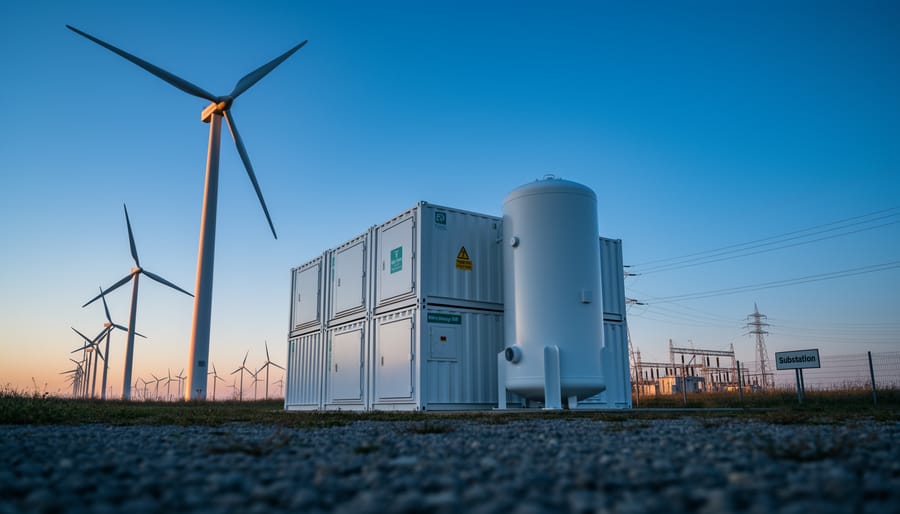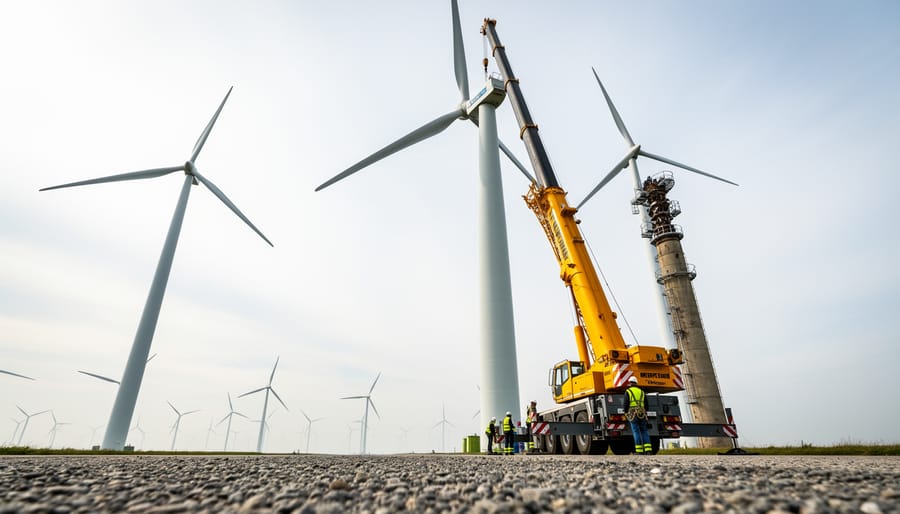
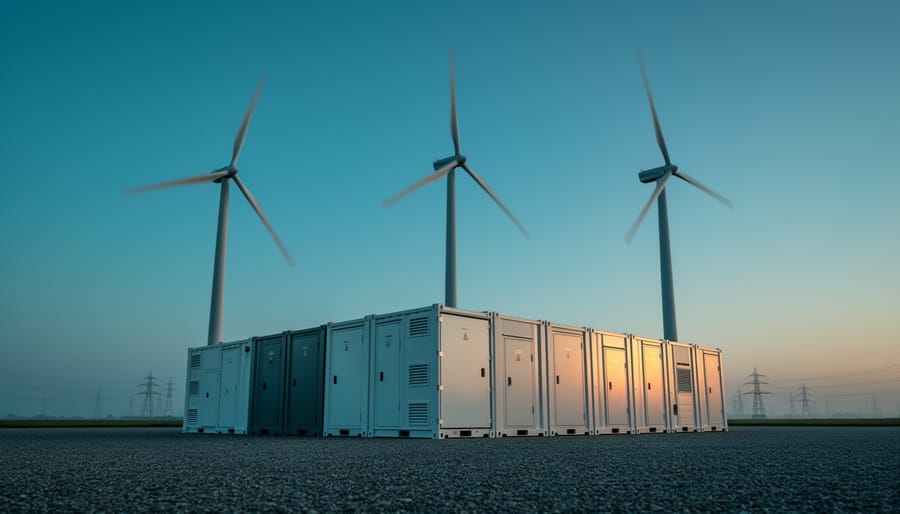
Energy storage innovations are transforming renewable power from an intermittent resource into a reliable backbone of the modern grid. While wind energy innovations have dramatically increased generation capacity, storage technologies now solve the fundamental challenge: capturing electricity when turbines spin and delivering it precisely when homes and businesses need power.
The storage revolution happening right now in 2026 isn’t about a single breakthrough. It’s a convergence of battery chemistries, mechanical systems, and thermal storage working together across different time scales. Lithium-ion systems handle fluctuations measured in seconds or hours. Flow batteries bridge the gap with 6-12 hour discharge cycles. Compressed air and gravity-based storage extend that window to days or even weeks.
Real deployments prove these aren’t laboratory concepts. The Merus ESS system in Texas now stabilizes grid frequency for a 400MW wind farm, responding in milliseconds to demand shifts. In California, iron-air batteries at the Barstow facility store excess solar and wind for 100-hour discharge periods, essentially creating a weather-independent power plant. These installations represent over $180 billion in global energy storage investments this year alone, according to the International Energy Agency.
What makes 2026 different from even two years ago? Storage costs have dropped below critical thresholds where wind-plus-storage competes directly with fossil fuel plants on economics, not just environmental merit. A lithium iron phosphate system now costs $132 per kilowatt-hour compared to $180 in 2024. More importantly, utilities are installing storage at unprecedented scale: 89 gigawatts of new capacity came online in the first half of this year.
This article examines the specific technologies making wind power dependable, the case studies proving their effectiveness, and what these advances mean for your energy future.
Why Wind Energy Desperately Needs Storage
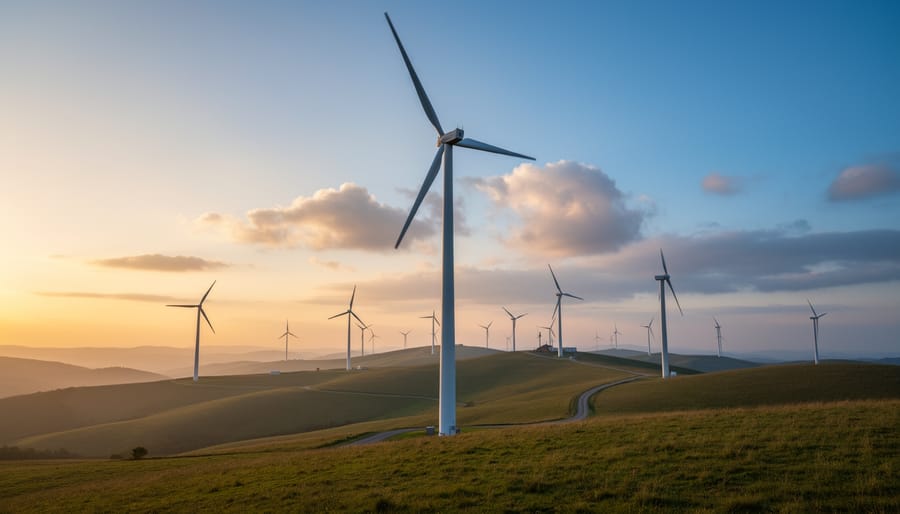
Wind turbines only generate electricity when the wind blows, and the wind doesn’t follow our schedules. This fundamental mismatch between when renewable energy is produced and when we need it creates a reliability gap that storage innovations are now solving.
The problem runs deeper than occasional calm days. Wind output can swing dramatically within hours, dropping from maximum capacity to near zero as weather systems shift. A wind farm might produce surplus electricity at 2 a.m. when demand is low, then generate nothing during the evening peak when homes and businesses need power most. Traditional grids were built around predictable, dispatchable power plants that operators could ramp up or down on command. Wind doesn’t work that way.
This variability has real consequences. Grid operators maintain strict balance between supply and demand every second of every day, too much imbalance triggers blackouts. When wind comprises a small fraction of the grid, operators can compensate by adjusting conventional power plants. But as wind capacity grows toward meaningful percentages of total generation, those backup plants can’t respond quickly enough to smooth out the fluctuations. The grid becomes unstable.
The infrastructure itself wasn’t designed for this challenge. Transmission lines carry power in one direction, from centralized plants to consumers. Wind farms often sit in remote locations far from demand centers, and the grid lacks capacity to move large volumes of intermittent power around. Without storage to capture excess wind energy when it’s plentiful and release it during shortages, utilities face an impossible choice: curtail clean wind production when demand is low, or risk grid instability.
Storage innovations eliminate this trade-off. They decouple generation from consumption, allowing wind farms to contribute steady, reliable power regardless of current weather conditions.
Battery Technologies Transforming Wind Storage
Lithium-Ion: The Current Workhorse
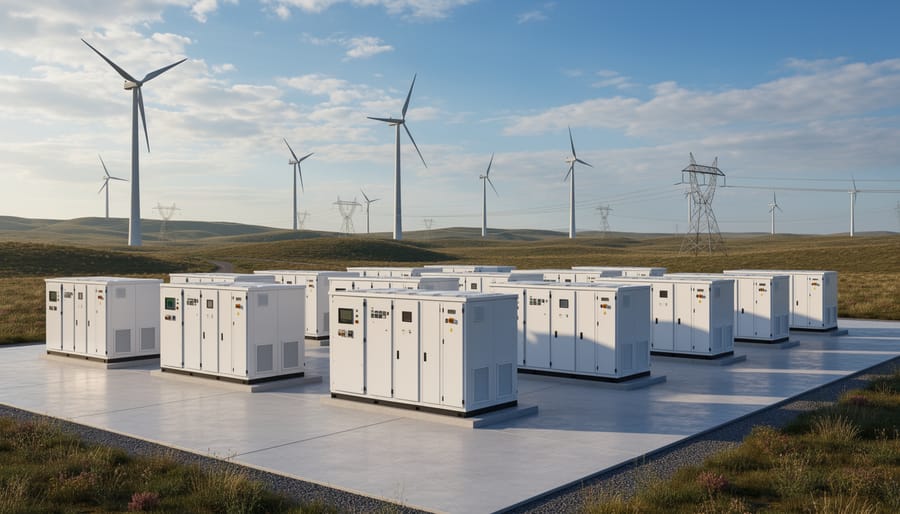
Lithium-ion batteries currently dominate wind energy storage for a straightforward reason: they work reliably right now. These systems provide 4-10 hours of storage, a sweet spot that handles the daily fluctuations in wind production most farms experience. When wind speeds peak overnight but demand is low, Li-ion batteries soak up the excess. Come morning rush hour, they discharge that stored energy precisely when the grid needs it most.
The technology’s proven track record in everything from electric vehicles to grid applications means wind farm operators can deploy it with confidence. Response times are nearly instantaneous, ramping from zero to full output in milliseconds, which is why they excel at smoothing out sudden drops in wind speed. Installation is relatively straightforward compared to mechanical storage alternatives, and the efficiency is impressive, most systems convert over 90% of the energy they store back into usable electricity.
But those same grid-scale storage durations that work well for daily cycles hit a wall when wind patterns shift for days at a time. A multi-day calm spell can drain a Li-ion system completely, leaving the grid scrambling for backup power. The cost per kilowatt-hour remains stubbornly high for extended storage, which is exactly why the Department of Energy has set a target requiring a 90% cost reduction compared to 2020 baseline Li-ion costs. Until that happens, lithium serves as the reliable workhorse for short bursts, while the industry races to crack the longer-duration puzzle.
Beyond Lithium: Next-Generation Battery Chemistry
While lithium-ion batteries dominate today’s wind farms, their cost and limited duration capabilities have sparked a race toward alternatives better suited to renewable energy’s demands. Several promising chemistries are moving from laboratory curiosities to commercial deployment, each offering distinct advantages for wind integration.
Flow batteries represent one of the most mature alternatives. Unlike conventional batteries that store energy in solid electrodes, flow batteries pump liquid electrolytes through a cell stack. This design decouples power and energy capacity, you can scale storage duration by simply adding bigger tanks of electrolyte without changing the power system. Vanadium redox flow batteries are already operating at utility scale, offering 6-12 hours of storage with minimal degradation over 20+ years. Their longer lifespan and easier recyclability make them particularly attractive for wind farms planning decades of operation.
Sodium-ion batteries are gaining momentum as a cost-effective lithium alternative. Sodium is abundant and cheap, table salt is sodium chloride, eliminating the supply chain vulnerabilities that plague lithium. Recent breakthroughs have pushed sodium-ion energy density closer to lithium levels while maintaining better thermal stability. Several manufacturers began commercial production in 2025, with costs already 20-30% below lithium-ion equivalents. For wind farms in regions with abundant salt resources, the economics are compelling.
| Battery Type | Storage Duration | Best Wind Application | Development Status |
|---|---|---|---|
| Vanadium Flow | 6-12 hours | Daily cycling, long operational life | Commercial deployment |
| Sodium-Ion | 4-8 hours | Cost-sensitive projects, thermal stability needs | Early commercial production |
| Solid-State | 8-16 hours | Compact footprint, extreme climates | Pilot projects |
Solid-state batteries replace liquid electrolytes with solid materials, boosting energy density while improving safety. They can potentially store 50% more energy in the same space as lithium-ion cells, crucial when land availability constrains wind farm development. Though still in pilot phases, solid-state systems show promise for offshore installations where space comes at a premium and the stable temperature range reduces fire risk.
These next-generation chemistries aren’t replacing lithium tomorrow, but they’re carving out niches where their specific strengths align with wind energy’s varied storage needs.

Real-World Implementation: The Merus® ESS Case Study
Finland’s Merus® ESS demonstrates how storage technology translates into practical grid support. This system doesn’t just store excess wind energy, it actively participates in frequency regulation markets, turning energy storage into a revenue-generating asset for wind farm operators.
When wind turbines produce more power than the grid can immediately use, the Merus® ESS absorbs the surplus. During periods when wind slows and demand remains high, it releases that stored energy, smoothing out the inherent variability that makes grid operators nervous about wind power. This balancing act happens continuously, matching production curves with consumption patterns in real time.
The system’s participation in Frequency Reserve markets adds another dimension. Grid frequency must remain stable within tight tolerances (typically 50 Hz in Europe, 60 Hz in North America). The Merus® ESS responds within milliseconds to frequency deviations, injecting or absorbing power as needed to maintain stability. This fast-response capability is particularly valuable as grids incorporate more wind capacity, since traditional spinning reserves from fossil fuel plants are being phased out.
This dual function, time-shifting wind energy and providing ancillary grid services, showcases why energy storage innovations matter beyond simply banking kilowatt-hours. They transform wind farms from intermittent generators into dispatchable power plants that grid operators can count on, while creating additional income streams that improve project economics.
Long-Duration Storage: The Game Changer
Technologies Leading the Long-Duration Revolution
Four distinct technologies are bridging the gap between wind generation and continuous power supply, each solving the multi-day storage puzzle in radically different ways.
Compressed air energy storage turns wind farms into giant pneumatic batteries. Excess electricity drives compressors that force air into underground caverns, depleted natural gas reservoirs, or specially designed tanks. When the wind stops, the pressurized air spins turbines to regenerate electricity. This approach scales to massive capacities and can discharge for dozens of hours, making it ideal for matching weekly wind patterns. The underground geology acts as a free storage vessel, reducing costs compared to building equivalent battery banks.
Gravity-based systems harness the simplest physics: lifting heavy masses when wind turbines generate surplus power, then releasing them to drive generators during calm periods. Some designs stack concrete blocks in towers, while others raise weighted pistons in deep shafts. The technology has virtually no degradation over thousands of cycles, and the materials are abundant and recyclable. Sites with elevation changes or decommissioned mine shafts gain a second life as energy vaults.
Thermal storage captures wind energy as heat, storing it in molten salt, ceramic blocks, or superheated water. These systems hold energy for up to a week and convert back to electricity through steam turbines. The storage medium is cheap, and the technology integrates well with industrial processes that need both electricity and heat.
Hydrogen production offers the longest duration potential. Electrolyzers use surplus wind power to split water into hydrogen and oxygen. The hydrogen can fuel vehicles, feed industrial processes, or power turbine generators months later. While conversion efficiency is lower than batteries, hydrogen’s energy density and versatility make it compelling for seasonal storage needs.
The Cost Challenge and DOE’s Ambitious Target
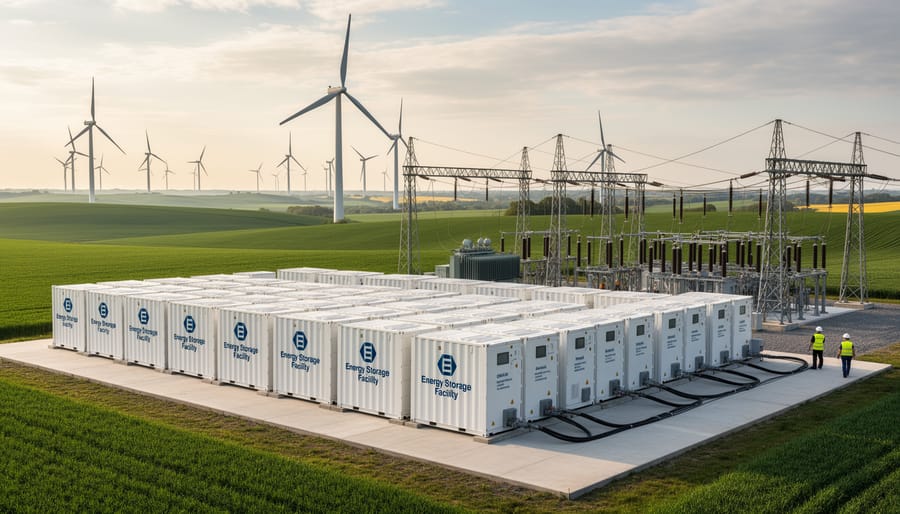
The Department of Energy has set an aggressive benchmark for energy storage breakthroughs: long-duration systems must achieve a 90% cost reduction compared to the 2020 baseline cost of lithium-ion batteries. It’s a demanding target, but one that reflects the economic reality wind farms face. Without dramatic cost cuts, seasonal storage remains too expensive for widespread deployment.
Current lithium-ion systems provide 4 to 10 hours of storage, which works well for daily cycling but becomes prohibitively expensive when stretched to the multiday or weekly durations that wind patterns require. The DOE’s goal pushes developers to rethink everything from materials to manufacturing scale, forcing innovations that trade lithium’s high power density for the low-cost, long-duration capabilities wind integration actually needs.
Progress is measurable. Emerging technologies like flow batteries, compressed air systems, and thermal storage are closing the cost gap by using abundant materials and leveraging economies of scale. These alternatives sidestep lithium’s supply chain constraints while targeting the exact duration sweet spot that makes wind reliable across weather patterns. The offshore energy storage market’s explosive growth from $0.77 billion in 2026 toward a projected $16.16 billion by 2035 signals investor confidence that this cost barrier will fall, unlocking the seasonal storage capacity that transforms wind from intermittent to dependable.
Offshore Wind Storage: The Next Frontier
Why Offshore Demands Different Solutions
Offshore wind farms face challenges that onshore installations simply don’t encounter. Saltwater corrosion attacks battery components and electrical connections, requiring specialized protective casings and materials that drive up costs. The constant motion from waves and wind creates mechanical stress that can damage sensitive storage equipment, demanding ruggedized designs far beyond what land-based systems need.
Distance compounds these problems. Offshore wind farms often sit 20 to 50 miles from shore, making maintenance trips expensive and weather-dependent. A technician can drive to a land-based battery facility in an hour; reaching an offshore storage platform might require helicopter transport and waiting days for calm seas. This accessibility gap means offshore storage must be extraordinarily reliable since quick fixes aren’t an option.
Space constraints force different thinking too. Offshore platforms have limited real estate, so storage systems must deliver high energy density in compact footprints. Technologies that work well on land, where you can simply add more containers, don’t translate directly to marine platforms where every square meter counts and weight matters for structural stability.
Temperature fluctuations in marine environments, from freezing winter storms to summer heat, stress battery chemistry in ways that don’t happen in climate-controlled land facilities. Add the risk of flooding during severe weather, and it becomes clear why offshore storage requires purpose-built solutions rather than adapted land technologies. These harsh conditions explain why specialized marine-rated systems cost significantly more than their terrestrial counterparts, even as the 40.2% annual market growth signals confidence that engineers are solving these challenges.
Explosive Market Growth Signals Confidence
The offshore energy storage market tells a remarkable story of investor confidence in these innovations. Starting from $0.77 billion in 2026, projections show growth to $16.16 billion by 2035, a staggering 40.2% compound annual growth rate that reflects the industry’s conviction in offshore wind’s future.
This isn’t speculative enthusiasm. The investment surge signals that energy companies, utilities, and financial institutions see offshore wind storage as a proven, scalable solution rather than an experimental technology. When capital flows at this velocity, it accelerates everything: research and development cycles shorten, manufacturing scales up, costs drop through economies of scale, and deployment timelines compress.
What does this money actually buy? First, it funds the specialized engineering needed to make storage systems survive harsh marine environments, salt spray, extreme weather, constant motion. Second, it finances the infrastructure to connect offshore wind farms to grid-scale storage, solving the logistical puzzle of storing gigawatt-hours of energy miles from shore. Third, it supports the workforce training and supply chains necessary to install and maintain these systems at scale.
The market’s expansion also creates a virtuous cycle. As more projects come online, performance data accumulates, designs improve, and risk premiums decrease. Insurance costs fall, financing becomes cheaper, and projects that seemed marginal suddenly pencil out. By 2035, offshore wind storage won’t be innovative, it’ll be standard infrastructure, as unremarkable as transformers on power lines.
Hybrid Storage Systems: Combining Technologies for Optimal Performance
Wind farms increasingly combine multiple storage technologies, each handling what it does best, to create resilient systems that deliver power when it’s needed. A lithium-ion battery might provide quick-response reserves for the first four to ten hours after the wind dies down, while a compressed air or gravity system takes over for longer stretches, storing energy for days or even weeks. This layered approach addresses the hour-to-hour variability that makes wind vs solar integration such a grid challenge, ensuring that renewable electrons are available whether demand spikes at 3 p.m. or 3 a.m.
The Merus® ESS demonstrates this principle in action, balancing production and consumption while participating in Frequency Reserve markets, smoothing out the rapid fluctuations that can destabilize grids. By pairing fast-acting batteries with longer-duration mechanical or thermal storage, operators optimize both performance and cost. Short bursts come cheap from lithium-ion, while mechanical systems handle sustained discharge without the expense of massive battery banks.
Hybrid configurations also hedge against technology risk. As the Department of Energy pushes for a 90% cost reduction in long-duration storage compared to 2020 lithium-ion baselines, wind farms deploying hybrid systems today can swap in new technologies as they mature without overhauling the entire infrastructure. This flexibility strengthens grid reliability and positions operators to capture efficiency gains as innovations advance, turning storage from a single-solution gamble into a diversified, future-ready portfolio.
What These Innovations Mean for Your Energy Future
These storage breakthroughs aren’t just technical achievements, they’re reshaping how you’ll power your home and community. As battery costs drop toward the Department of Energy’s 90% reduction target and the offshore storage market surges from $0.77 billion in 2026 to a projected $16.16 billion by 2035, expect cheaper electricity bills and fewer blackouts. Wind farms equipped with long-duration storage will deliver power when you need it, not just when the wind blows, cutting carbon emissions while strengthening energy independence. The innovations profiled here are already balancing grids through systems like Merus® ESS and proving that wind can reliably anchor a sustainable future one where renewable energy works around the clock.