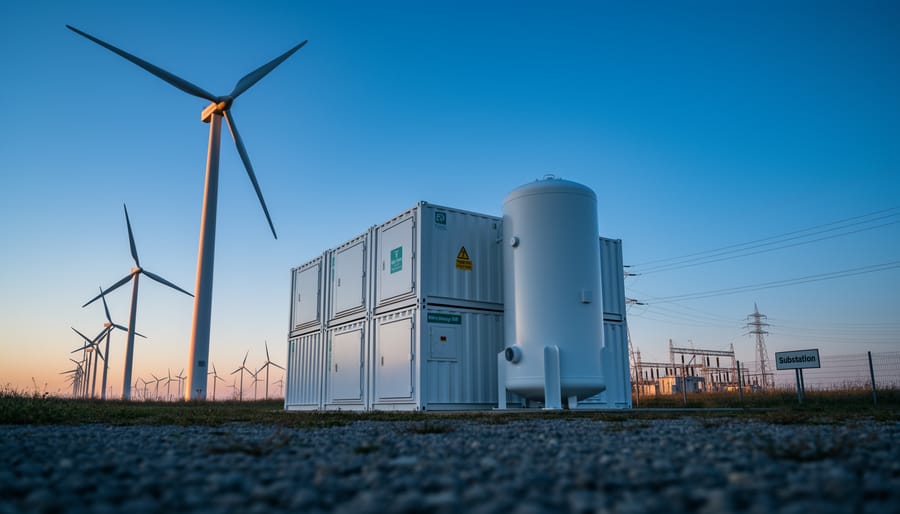
Energy storage innovations refer to the advanced technologies that capture electricity generated by wind turbines and release it on demand, solving the fundamental challenge that wind doesn’t blow consistently. These systems transform wind from an unpredictable energy source into a reliable power supply that can compete with fossil fuels around the clock.
The stakes couldn’t be higher. Wind energy has grown exponentially over the past decade, with global capacity reaching record levels in 2026. Yet for all its promise, wind power faces a critical limitation: turbines only generate electricity when the wind blows, while our homes and businesses need power 24 hours a day. On a calm summer afternoon, wind farms sit idle. During a windy night when demand is low, they produce more electricity than the grid can handle. This mismatch between generation and consumption has historically made it difficult for wind to serve as a primary energy source.
That’s precisely where storage innovations step in. Today’s technologies can capture surplus wind energy during peak production periods and dispatch it hours or even days later when it’s actually needed. Battery systems, compressed air facilities, thermal storage, and emerging solutions like liquid air energy storage are make wind work around the clock possible for the first time in history.
This article breaks down how these storage technologies actually work, examines the main systems changing the landscape in 2026, and explores real-world installations proving that wind plus storage can reliably power entire communities. Whether you’re tracking the renewable transition or considering how storage fits into your organization’s energy strategy, understanding these innovations reveals why experts now view wind energy not as a supplement to traditional power, but as a cornerstone of a carbon-free grid.
What Energy Storage Innovations Mean for Wind Power
Energy storage innovations for wind power are technologies and systems that capture electricity generated by wind turbines and hold it until the grid needs it, solving the mismatch between when the wind blows and when people use power. This matters because wind is inherently unpredictable, it might gust at night when demand is low and die down during a hot summer afternoon when air conditioners strain the grid. Without storage, grid operators must either curtail (waste) excess wind generation or rely on fossil fuel plants to fill gaps when the wind stops.
The fundamental challenge is variability. Unlike coal or gas plants that produce steady, controllable output, wind farms generate electricity only when weather conditions cooperate. Traditional grids were built for dispatchable generation, so integrating large amounts of wind requires a way to decouple production from consumption. Storage technologies act as that buffer, absorbing surplus electricity during windy periods and releasing it hours or even days later when generation drops but demand persists.
- Intermittency
- The variable, non-constant nature of wind energy generation due to changing weather patterns and wind speeds. This unpredictability makes storage essential for reliable grid integration.
- Grid-scale storage
- Energy storage systems large enough to serve utility networks, typically measured in megawatt-hours or gigawatt-hours. These installations stabilize supply and demand across entire regions.
- Discharge duration
- How long a storage system can deliver power at its rated capacity before depleting. Short-duration systems provide hours of backup, while long-duration options cover days or weeks.
- Round-trip efficiency
- The percentage of electricity recovered from storage compared to what was originally put in. Higher efficiency means less energy lost during the storage and retrieval process.
- Capacity
- The total amount of energy a storage system can hold, typically measured in megawatt-hours (MWh) or kilowatt-hours (kWh). Larger capacity allows more wind energy to be banked for later use.
Innovation in this space has accelerated because both wind energy innovations and policy pressures demand it. As turbines grow larger and wind farms proliferate, the volume of intermittent electricity flooding grids has surged. Modern storage solutions differ from past approaches in several ways: they’re cheaper (battery costs have dropped over 80% in the past decade), more diverse (ranging from lithium-ion to compressed air to hydrogen), and smarter (AI now optimizes when to charge and discharge). Earlier systems were often one-size-fits-all and prohibitively expensive; today’s options are tailored to specific needs, short bursts for frequency regulation, multi-hour coverage for evening peaks, or seasonal reserves for extended calm periods. This flexibility makes wind competitive with dispatchable sources and, when comparing solar vs wind gives wind an edge in regions with strong nighttime or winter wind resources that storage can capture and deploy on demand.
How Wind Energy Storage Systems Work
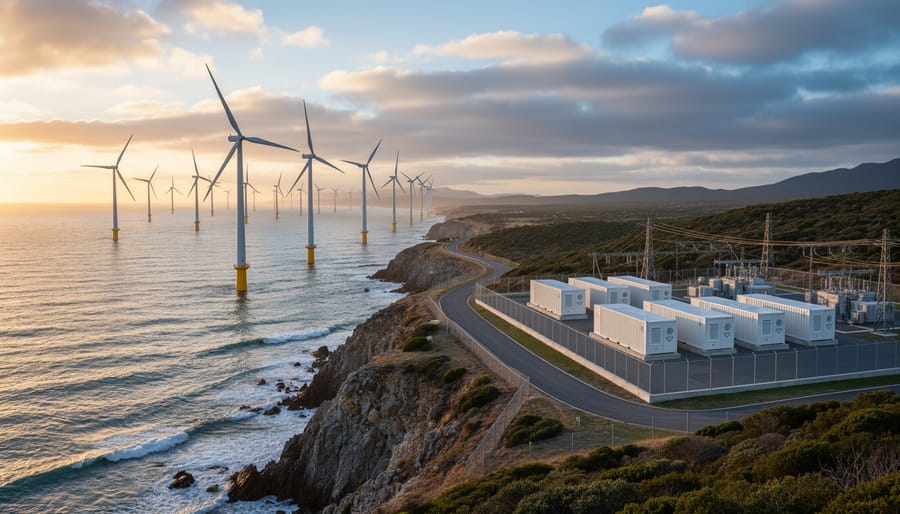
Wind energy storage begins the moment turbine blades spin faster than the grid needs. Instead of curtailing that excess power, essentially throwing it away, storage systems capture the electricity and hold it until demand rises or the wind stops blowing. This three-stage process transforms intermittent wind generation into reliable, dispatchable energy.
The capture phase happens in real time. When wind farms produce more electricity than the local or regional grid can absorb, automated control systems detect the surplus and divert it to connected storage facilities. This decision occurs within milliseconds, coordinated by grid operators who balance supply and demand across entire networks. Modern wind farms integrate directly with storage infrastructure through high-voltage inverters and transformers that manage the flow of electrons seamlessly.
Once captured, the electricity undergoes conversion. Battery systems store energy chemically by driving lithium ions or other charge carriers between electrodes, creating potential energy that sits ready for discharge. Mechanical storage converts electricity into kinetic or gravitational energy, pumping water uphill, compressing air into underground caverns, or spinning massive flywheels. Thermal approaches use electricity to heat materials like molten salt or cool air into liquid form, banking energy as temperature differentials. Each method trades efficiency and speed for capacity and duration; batteries respond in milliseconds but typically store hours of energy, while pumped hydro can hold gigawatt-hours but takes minutes to ramp up.
Dispatch reverses the conversion. When wind slows or evening demand peaks spike electricity prices, storage systems release their banked energy. Batteries push ions back through the circuit, generating current. Pumped hydro lets water cascade downhill through turbines. Compressed air expands to drive generators. Grid operators orchestrate this release using predictive algorithms that forecast wind patterns and demand curves hours or days ahead, optimizing when to charge versus discharge for maximum economic and grid-stability value.
Integration between wind farms and storage varies by scale and location. Large wind projects often pair with dedicated battery installations on-site, minimizing transmission losses. Offshore wind parks might store energy as hydrogen, piping it ashore separately from the electrical grid. In some regions, wind operators sell excess power to independently owned storage facilities that profit by buying low during windy periods and selling high during calm peaks. The result is a dynamic ecosystem where storage acts as both a buffer and a bridge, smoothing wind’s natural fluctuations into steady, predictable supply.
Major Categories of Wind Energy Storage Technologies
Advanced Battery Storage Systems
Advanced Battery Storage Systems
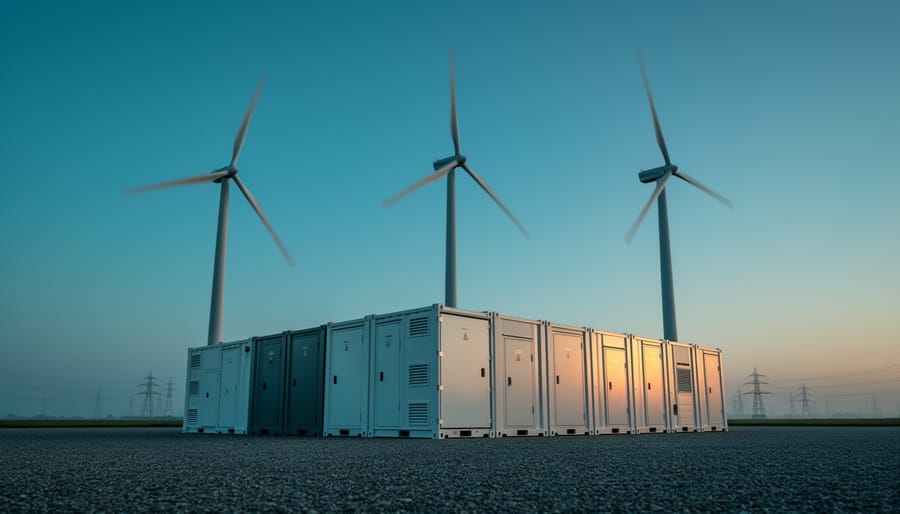
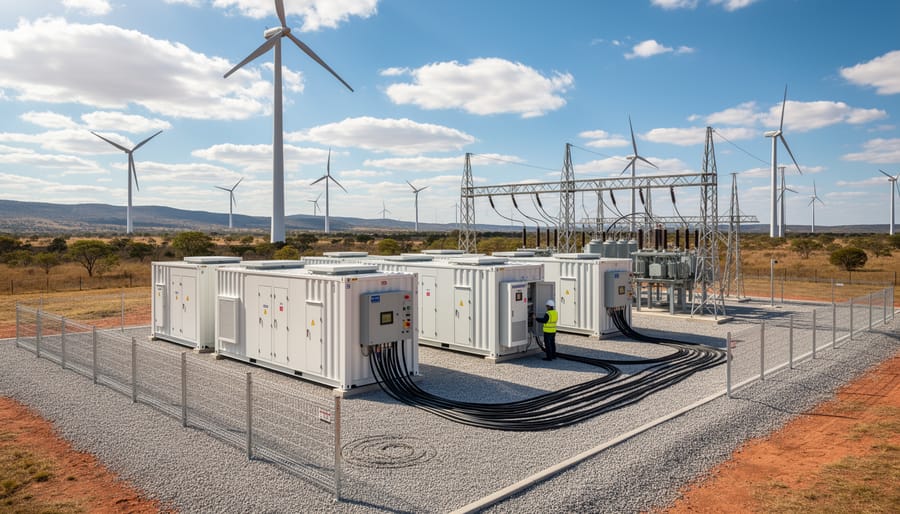
Lithium-ion batteries have evolved dramatically from their early wind energy applications. Modern utility-scale lithium iron phosphate (LFP) systems now deliver 2-4 hour discharge durations at capacities reaching 300 MW, with cycle lifetimes exceeding 6,000 charge-discharge cycles. What makes them innovative is the integration of sophisticated thermal management and modular architectures that reduce degradation rates by 40% compared to 2020-era installations. When wind generation spikes, these batteries absorb excess electricity through inverter systems that convert AC to DC for storage, then reverse the process during low-wind periods to maintain grid frequency within tight tolerances.
Solid-state batteries represent the next frontier for wind storage, replacing liquid electrolytes with ceramic or polymer materials. This design eliminates fire risk and nearly doubles energy density, meaning the same storage capacity fits in half the physical footprint. Several pilot projects in Europe now pair solid-state units with offshore wind farms, where space constraints and harsh marine conditions make conventional batteries impractical. Commercial availability remains limited, but manufacturers project costs to reach parity with lithium-ion by 2028.
Flow batteries solve a different problem: ultra-long discharge durations. Vanadium redox flow systems store energy in liquid electrolyte tanks that can be scaled independently from power output. A single installation might deliver 10-12 hours of continuous discharge, absorbing midday wind surpluses and releasing power through evening demand peaks. The electrolyte doesn’t degrade chemically, giving flow batteries 20-year lifespans with minimal capacity loss.
Sodium-ion batteries have emerged as a cost-effective alternative where materials availability matters. They use abundant sodium instead of scarce lithium, cutting raw material costs by roughly 30%. Their lower energy density makes them less suitable for space-constrained sites, but for sprawling inland wind farms with available land, sodium-ion arrays provide reliable 2-3 hour storage at compelling economics.
Mechanical Storage Solutions
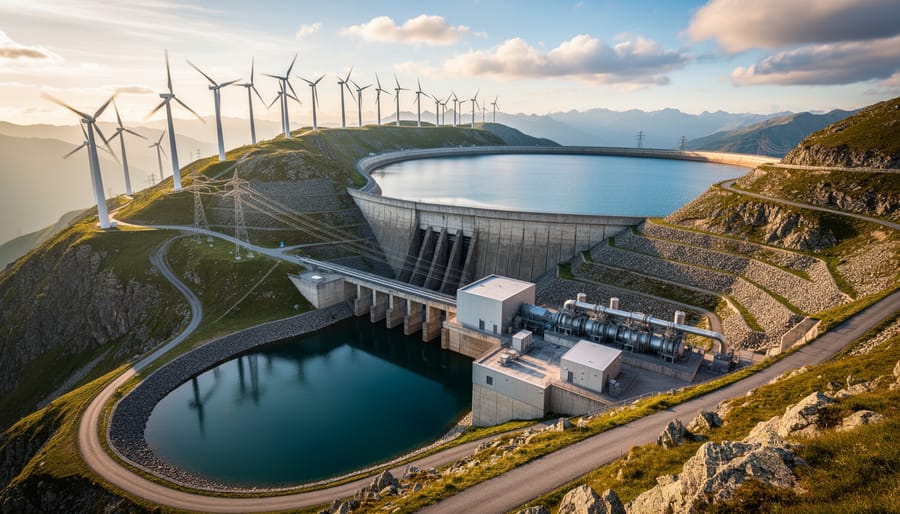
Mechanical storage converts wind-generated electricity into physical energy, either by moving mass, compressing air, or spinning a rotor, and releases it back when needed. These systems excel at large-scale, grid-level storage and typically deliver longer discharge durations than early-generation batteries.
Pumped hydro storage remains the most mature and widely deployed mechanical option. Excess wind power pumps water uphill to a reservoir; when demand spikes or wind drops, the water flows back down through turbines to generate electricity. A single pumped hydro facility can store gigawatt-hours of energy and discharge for several hours or even days. The trade-off: you need significant elevation change and two reservoirs, which limits suitable locations to mountainous or hilly terrain. Roughly 90% of grid-scale energy storage worldwide still comes from pumped hydro, underscoring its proven scalability.
Compressed air energy storage (CAES) uses surplus wind electricity to compress air into underground caverns, typically salt domes or depleted gas fields, then releases it through turbines when power is needed. CAES plants can operate for hours at hundreds of megawatts, making them viable for regions lacking elevation change. However, suitable geology is essential, and some designs burn natural gas during discharge to reheat the compressed air, which reduces carbon benefits. Advanced adiabatic CAES systems capture and reuse compression heat, eliminating fossil fuel combustion.
Flywheel storage spins a rotor to extremely high speeds in a vacuum chamber, storing energy as angular momentum. Flywheels respond in milliseconds, stabilizing grid frequency fluctuations caused by sudden wind gusts or lulls. They’re ideal for short-duration support, seconds to minutes, rather than multi-hour storage, and often pair with batteries in hybrid setups to handle both rapid response and sustained discharge.
Thermal and Hydrogen-Based Storage
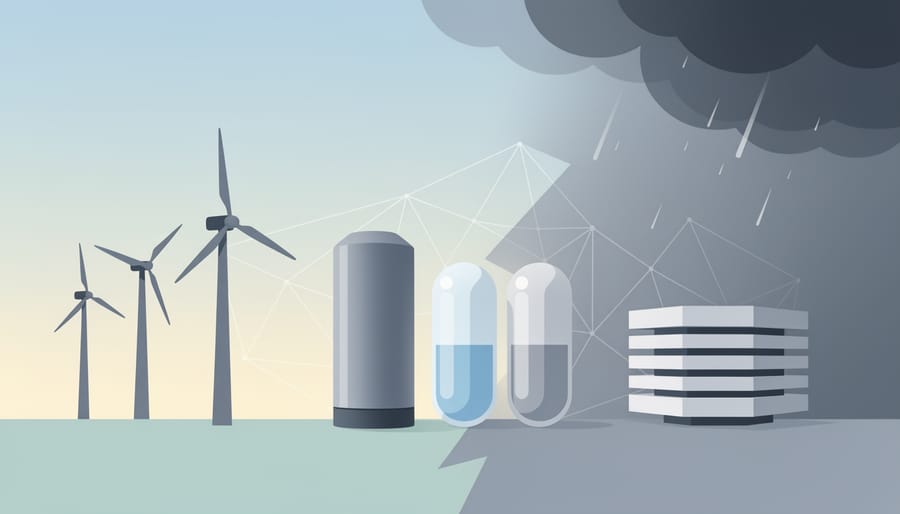
Wind energy can be stored not just as electricity but as heat or as chemical energy, opening pathways for storage durations measured in days or weeks rather than hours. These approaches excel where batteries fall short: long-term, seasonal storage and industrial applications beyond the electricity grid.
Molten salt thermal storage captures excess wind electricity by heating liquid salt mixtures to temperatures exceeding 500°C. The molten salt retains thermal energy efficiently for extended periods, then releases it on demand to generate steam and drive turbines when wind output drops. Originally developed for concentrated solar plants, molten salt systems are now being adapted for wind farms, particularly in regions where wind patterns and heating demand align seasonally. Storage durations can extend from several days to weeks, making this technology valuable for bridging multi-day lulls in wind generation.
Liquid air energy storage (LAES) takes a different route: wind electricity powers cryogenic equipment that compresses and cools air to minus 196°C, transforming it into liquid form. When electricity is needed, the liquid air is warmed, expands rapidly back into gas, and spins turbines to regenerate power. LAES facilities can store energy for weeks without significant losses and require no rare materials, relying instead on industrial gases and proven cryogenic engineering. Commercial-scale LAES plants are operating in the UK, demonstrating the technology’s viability for grid-scale deployment.
Green hydrogen production converts wind electricity into hydrogen gas through electrolysis, splitting water molecules. The hydrogen can be stored indefinitely in tanks or underground caverns, then burned for heat, fed into fuel cells for electricity, or used directly in industrial processes like steel manufacturing and chemical production. This versatility makes hydrogen particularly valuable: it decarbonizes sectors batteries cannot easily reach. Projects in Germany, Australia, and Chile are now producing green hydrogen at wind farms, with capacities scaling rapidly as electrolyzer costs decline and industrial demand grows. Storage duration is virtually unlimited, constrained only by tank or cavern size.
Hybrid and Smart Storage Systems
Pairing complementary storage technologies delivers what single systems can’t: a battery might handle short-term fluctuations in wind generation while a hydrogen electrolyzer converts surplus electricity into fuel for weeks-long storage. One Texas wind farm couples lithium-ion banks with compressed air storage, using batteries to smooth minute-to-minute grid demands and CAES to absorb multi-hour production peaks. The lithium responds in milliseconds; the compressed air holds gigawatt-hours for later dispatch. This layered approach matches storage characteristics to actual grid needs rather than forcing one technology to do everything.
Artificial intelligence now orchestrates these hybrid setups. Machine learning algorithms ingest weather forecasts, electricity price signals, and grid frequency data to decide which storage medium charges or discharges at any moment. A system in Scotland routes wind power to flywheels during brief lulls, batteries during evening demand surges, and hydrogen production when prices drop below a threshold, all without human intervention. The software learns seasonal patterns and adjusts strategies as conditions shift.
Smart controllers also extend equipment life by minimizing stress. Instead of cycling batteries through their full range daily, AI splits duty cycles across multiple assets, reducing degradation. Early deployments report fifteen percent longer battery lifespans and twenty percent better round-trip efficiency compared to manual operation, proving that intelligent coordination turns diverse storage components into a unified, adaptive energy reservoir.
Real-World Applications and Case Studies
Wind energy storage innovations have moved beyond pilot projects into commercial-scale operations that demonstrate how these technologies solve real-world challenges. The Hornsdale Power Reserve in South Australia, paired with the Hornsdale Wind Farm, remains one of the most cited success stories since its 2017 launch. This 150 MW lithium-ion battery system can dispatch 194 MWh of stored wind energy within milliseconds, preventing grid blackouts that previously cost the region millions. In its first year alone, the facility saved approximately $40 million in grid stabilization costs while reducing frequency control prices by 90 percent.
Island communities have become proving grounds for integrated wind-storage systems, where diesel dependency and isolation create both necessity and opportunity. El Hierro in Spain’s Canary Islands operates a combined wind-hydro system where five turbines generate electricity that powers pumps to move water uphill into a reservoir. When wind drops, the water flows back down through turbines, creating a closed-loop system that has achieved renewable energy coverage exceeding 50 percent of the island’s annual needs. This eliminates roughly 6,000 tons of diesel fuel imports yearly.
Offshore wind integration presents unique storage challenges that recent projects are addressing through innovative proximity solutions. The Hywind Tampen floating wind farm off Norway, operational since late 2022, supplies power to offshore oil platforms while testing battery storage modules mounted directly on floating platforms. This eliminates transmission losses and demonstrates how storage can follow generation to remote locations rather than requiring mainland infrastructure.
Utility-scale hybrid systems are increasingly common as developers recognize that pairing storage from the outset improves project economics and grid value. The Gateway Energy Storage project in California combines 230 MW of battery capacity with existing wind generation, allowing the facility to shift output to evening peak demand periods when wholesale prices triple. Similar configurations are emerging globally, often tied to repowering wind farms with modern, higher-capacity turbines that generate surplus energy ideally suited for storage.
Long-duration storage deployments remain rarer but are gaining traction. The McIntosh compressed air facility in Alabama, though originally built in 1991, has undergone upgrades that allow it to store wind energy from regional farms in underground salt caverns, providing up to 26 hours of discharge. Newer projects like the proposed Utah CAES system aim for 1,000 MW capacity with similar multi-day storage capabilities, specifically designed to balance high wind generation periods across entire Western U.S. states.
These operating examples validate that wind storage technologies work at commercial scale, deliver measurable financial returns, and enable higher renewable penetration than previously achievable.
Benefits and Challenges of Wind Storage Innovations
Wind energy storage innovations deliver transformative benefits while confronting real-world obstacles that engineers and policymakers are actively working to overcome. On the advantage side, these technologies fundamentally change how wind power integrates into the electrical grid. Storage systems provide dispatchability, the ability to release electricity on demand rather than only when the wind blows, which turns an intermittent resource into a reliable one. Grid operators gain several critical capabilities:
- Dispatchability: releasing stored wind energy during calm periods or peak demand hours
- Frequency regulation: stabilizing grid voltage and frequency in milliseconds
- Peak shaving: reducing reliance on fossil fuel peaker plants during high-demand windows
- Renewable integration: enabling grids to reach 70-90% wind and solar penetration without instability
Beyond grid management, storage innovations slash wind curtailment, the practice of shutting down turbines when generation exceeds demand. In regions like Texas and Scotland, curtailment has cost wind operators millions in lost revenue; battery and hydrogen systems capture that excess energy instead. Storage also smooths electricity prices by charging when wholesale rates are low and discharging when they spike, creating arbitrage opportunities that improve project economics. From an environmental perspective, displacing natural gas peaker plants with stored wind energy cuts emissions and reduces the environmental impact on wildlife compared to building new fossil infrastructure.
The challenges, however, remain substantial. Capital costs for large-scale storage run into hundreds of millions of dollars, and while lithium-ion battery prices have dropped 90% since 2010, long-duration systems like flow batteries or hydrogen electrolyzers still carry steep upfront price tags. Materials sourcing raises concerns, lithium, cobalt, and vanadium supply chains face geopolitical and environmental scrutiny, prompting a push toward sodium-ion and other earth-abundant chemistries. Round-trip efficiency losses mean that 10-30% of the stored energy dissipates as heat during conversion and storage, depending on the technology. Permitting and siting present bottlenecks, especially for pumped hydro and compressed air projects that require specific geology. Grid interconnection queues stretch years long in some markets, delaying deployment even when financing is secured. Addressing these hurdles demands continued R&D, streamlined regulatory frameworks, and supply chain diversification to match the pace of wind capacity expansion.
Frequently Asked Questions
Energy storage innovations naturally prompt questions about practicality, cost, and performance. Here are answers to the most common concerns readers raise about wind energy storage systems.
How long can wind energy be stored?
Storage duration depends on the technology. Battery systems typically provide hours to a few days of storage, while pumped hydro and compressed air can store energy for weeks. Green hydrogen offers months-long storage potential, making it suitable for seasonal balancing.
What happens to stored energy over time?
All storage systems experience some energy loss through self-discharge and conversion inefficiencies. Lithium-ion batteries lose 1-5% monthly, while pumped hydro retains energy much longer with minimal losses. Hydrogen can be stored indefinitely with proper containment.
Are wind storage systems economically viable?
Viability depends on application and local conditions. Utility-scale battery costs have dropped 90% since 2010, making many projects profitable today. Pumped hydro remains cost-effective for large-scale, long-duration needs in suitable locations.
How do storage innovations affect electricity costs?
Storage reduces costs by eliminating wind curtailment, avoiding expensive peaker plants, and enabling higher renewable penetration. While adding upfront capital, storage often lowers overall system costs by maximizing cheap wind electricity use during high-demand periods.
What’s the environmental footprint of storage technologies?
Battery production requires mining lithium, cobalt, and other minerals, raising environmental concerns that recycling programs aim to address. Pumped hydro and CAES have minimal operational emissions but require significant land use. Hydrogen production is carbon-free when powered by wind but demands substantial water resources.
These considerations matter when evaluating which storage technology fits a particular wind project. Round-trip efficiency, how much electricity you get back compared to what you put in, ranges from 70-85% for batteries to 65-75% for compressed air and 30-40% for hydrogen (though hydrogen’s value lies in applications beyond electricity reconversion). The technology you choose hinges on whether you need fast response times, long-duration storage, or both.
Energy storage innovations have transformed wind power from an intermittent resource into a reliable pillar of the modern grid. By capturing excess generation during windy periods and releasing it when demand peaks or turbines slow, these technologies solve the fundamental mismatch that once limited wind energy’s potential. The advances we’ve explored, from grid-scale batteries and mechanical systems to hydrogen production and intelligent hybrid approaches, are already proving themselves in real-world projects across continents.
The trajectory is clear: costs continue falling, efficiency keeps improving, and deployment accelerates each year. What began as experimental pilot programs has evolved into standard infrastructure planning, with utilities and developers now designing wind farms with integrated storage as the default rather than the exception. This shift doesn’t just benefit the renewable energy sector. It strengthens grid resilience, reduces reliance on fossil fuel backup, and brings us measurably closer to a stable, affordable, zero-carbon electricity system.
As these innovations mature and scale, wind-plus-storage systems will become as commonplace as wind farms themselves, unlocking the full climate and economic benefits that clean energy promises.